
Food Restriction and Binge Eating: Breaking the Cycle
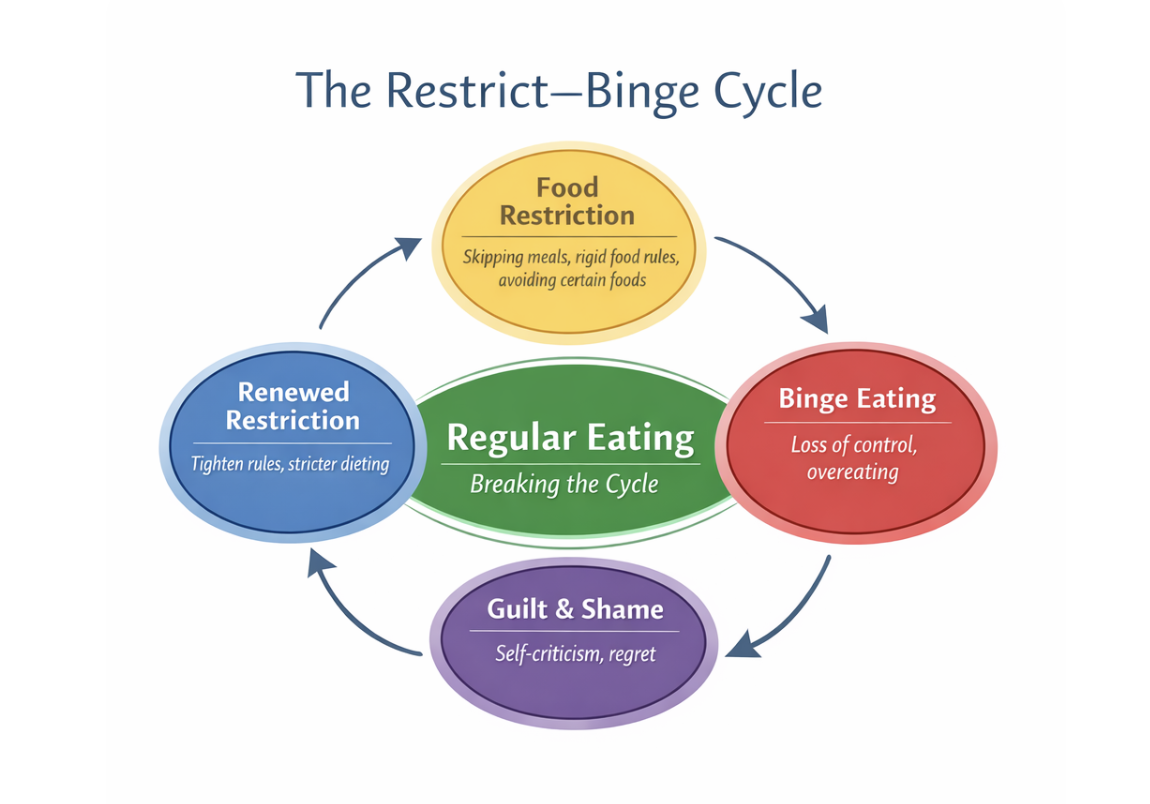
Many people who struggle with eating find themselves stuck in a frustrating cycle. They try to control their eating by restricting certain foods, skipping meals, or eating very little during the day. For a short time, it may feel like things are “under control.” But eventually the opposite happens: eating begins to feel overwhelming, and a binge occurs.
This pattern is extremely common and very well understood in eating disorder treatment. It is often called the restrict–binge cycle, and it is one of the key processes that keeps eating problems going.
Understanding how this cycle works is an important step toward breaking it.
The Problem with Restriction
Restriction can take many forms. Sometimes it means eating very small portions or skipping meals. Other times it shows up as strict rules about what foods are allowed or not allowed. People might try to avoid carbohydrates, sugar, or other foods they believe are “bad.”
Although restriction can feel like control at first, it places the body and brain under significant stress.
When the body does not receive enough food, biological survival systems activate. Hunger hormones increase and the drive to eat becomes stronger. The brain becomes more focused on food. People often notice that they are thinking about food constantly, planning meals in advance, or feeling distracted by hunger.
At the same time, restriction usually requires a great deal of mental effort. Maintaining strict food rules can be exhausting. Over time, the combination of physical hunger and psychological pressure builds.
Eventually, something gives. When eating does happen, it may feel difficult to stop. This is what people often describe as a binge.
Afterward, many people feel guilt or shame about what happened. In response, they often decide they need to be even stricter with food the next day. That renewed restriction restarts the cycle.
Why Food Rules Make Things Worse
Another factor that contributes to binge eating is rigid food rules.
When certain foods are labeled as “off limits,” they tend to become more emotionally charged. The brain begins to treat those foods as scarce or forbidden. As a result, cravings often increase.
When someone eventually does eat that food, it may trigger a sense of “I’ve already broken the rule,” which can make it harder to stop eating. This is sometimes called the “what the hell” effect.
Over time, the more foods are restricted, the more powerful this dynamic becomes.
The Role of Regular Eating
One of the most effective ways to interrupt the restrict–binge cycle is surprisingly simple: eating regularly and consistently throughout the day.
In cognitive behavioral therapy for eating disorders (CBT-E), people are encouraged to establish a structured pattern of eating. This usually means three meals and two or three snacks spaced across the day.
Regular eating helps stabilize blood sugar and reduces extreme hunger. It also helps the body learn that food is predictable and available, which decreases the sense of urgency around eating.
As this pattern becomes more consistent, the intense swings between restriction and overeating begin to settle.
Reintroducing Food Variety
Recovery also involves gradually expanding the range of foods someone eats.
When eating has become very rule driven, certain foods can feel frightening or out of control. Bringing those foods back in a structured way helps reduce their emotional power.
Over time, food becomes less charged and more neutral. Instead of feeling like something to fight against or control, it becomes simply one part of daily life.
Breaking the Cycle
The restrict–binge cycle can feel discouraging, but it is important to understand that it is not a sign of weakness or lack of willpower. It is a predictable response to deprivation.
When the body is underfed and the mind is under pressure, loss of control eating is a natural outcome.
Evidence based treatments such as Cognitive Behavioral Therapy for Eating Disorders (CBT-E) focus directly on these patterns. CBT-E helps people understand how restriction, rigid food rules, and irregular eating keep the binge cycle going. Through structured changes to eating patterns and shifts in thinking about food and body image, many people find that the intensity of urges around food decreases and eating becomes much more manageable.
When people learn how restriction fuels binge eating and begin to rebuild consistent, flexible eating patterns, the relationship with food often becomes calmer and more stable. What once felt like an exhausting battle can gradually become something far more manageable and predictable.
